

Dr. Moritz Liebeknecht
IP Dynamics GmbH
Billstraße 103
D-20539 Hamburg
Goodbye waiting - thanks to virtual waiting
With the “virtual waiting” function, callers avoid annoying queues and only pick up the phone again when a service employee is speaking.
Who likes to wait...? That's right: No one! Telephone queues in particular have a very bad reputation. Callers who actually only want to answer a quick question find waiting for minutes, usually with annoying musical accompaniment, as an imposition and a waste of time. While they wait to finally be turned through to a service agent, they balance the telephone between head and shoulder or set it aside when switched to the loudspeaker so that they can do other things at the same time.

The good news: There is another way! Thanks to IP Dynamics' “Virtual Waiting” service center feature, callers no longer have to wait with the handset in their hands. Instead, they only pick up the phone again when they reach their waiting position and a service employee is ready to speak. The principle is quickly explained. As soon as a customer dials the customer service extension and the predicted waiting time exceeds a defined value, they are offered the option of virtual waiting. First, the customer is greeted in a friendly manner by the language portal. This is followed by an announcement that the waiting service can be used due to the high volume of calls and that an automatic call back will take place after the waiting time has elapsed. The customer confirms orally or by pressing a button (DTMF). If he does not wish to accept the offer immediately, it can be renewed at a later date.
Based on the customer's phone number, the system recognizes whether they are calling from the mobile or fixed network. Landline customers are automatically called back at the end of their virtual waiting period and, thanks to the high prioritization of their call, are referred directly to a free agent in the service center. If the moment of the recall is inconvenient for them, they can first press a button to express their wish to be called back at a later date. In this way, the system gives customers maximum flexibility in the virtual waiting area. Mobile customers are flexible anyway. After their waiting period has ended, they will be asked by SMS to call back within a specified time window. If a mobile customer calls after the specified time window has elapsed, their prioritized waiting position expires and they are placed in the waiting area just like a regular caller.
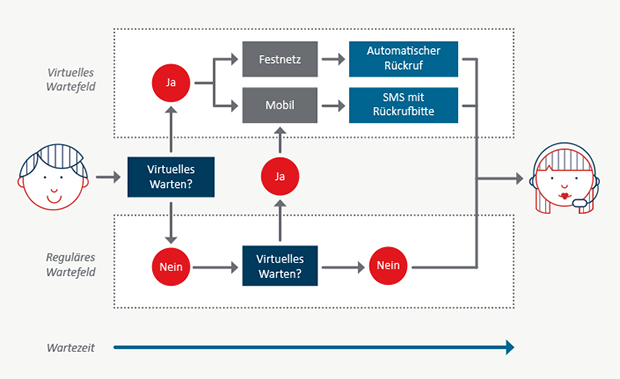
If the customer calls a second time before they have received their call back or the SMS with a call back request, the voice portal will kindly inform them that their waiting position has not yet been reached. He is then asked to hang up and wait for the appropriate notification or call. The work of agents in the service center is not affected by virtual waiting. The assignment of callers is automated. The Dynamic Flow contact center module from IP Dynamics plays the announcements and checks all conditions — for example, from which network a customer is calling. The module also handles routing and manages the logic of the virtual waiting area. It recognizes whether a caller has waited virtually and prioritizes him accordingly. The only thing left for the service employee is that virtually waiting customers are generally more relaxed and satisfied...
IP Dynamics virtual servicing
- Customer satisfaction increases thanks to the avoidance of annoying waiting loops
- Customers get maximum flexibility as they can have a say in the time of the recall
- Service employees have no additional work and are happy to welcome relaxed callers
- The routing and logic of virtual waiting are controlled by Dynamic Flow (DFW)


